There are moments in a witch’s journey when the world seems to hush itself… as if waiting for you to cross a threshold you didn’t know was there. Learning the runes is one of those moments. You aren’t simply memorizing symbols. You’re stepping into an ancient exchange between worlds… a conversation that began long before any of us took our first breath.
To understand the runes—truly understand them—you must first understand the world that breathed them into being. Not the softened, tourist-friendly version of Norse mythology… but the raw, bone-deep cosmology of a culture that looked into the dark and found meaning, structure, and power waiting to be named.
So before we touch a single stave, before we shape a single question for divination, let us begin where all sacred things begin… with the story that shaped the magic.
The World Before Runes: Norse Cosmology and the Roots of Power
Long before the runes were carved or cast, the Norse understood existence as a great weaving. Nine realms hung like shimmering worlds on the branches of Yggdrasil, the World Tree—a cosmic axis where gods, giants, spirits, and humankind lived out their tangled, necessary patterns.
This wasn’t a universe of binaries or absolutes. It was a world of forces—life and death, ice and fire, chaos and order—colliding and entwining to create motion. Creation itself began not with harmony, but with tension: the icy expanse of Niflheim meeting the fiery breath of Muspelheim, creating the first primordial beings from their meeting.
In this worldview, nothing existed in isolation. Even the gods were bound to the laws of fate, shaped and guided by the Nornir—three ancient beings who wove the destinies of all things at the base of Yggdrasil. These threads of fate were not “predetermined stories.” They were truths… currents… forces that ran through every action, every breath, every moment.
Against this backdrop, the runes were not invented. They were discovered—waiting in the hidden folds of creation like unspoken phrases, like the bones of reality.
And to claim them… someone had to be willing to pay the price for knowledge.
Odin’s Ordeal on Yggdrasil: The Sacrifice No God Should Survive
There is a reason the runes are not gentle tools.
They were not handed down with kindness… they were earned through agony.
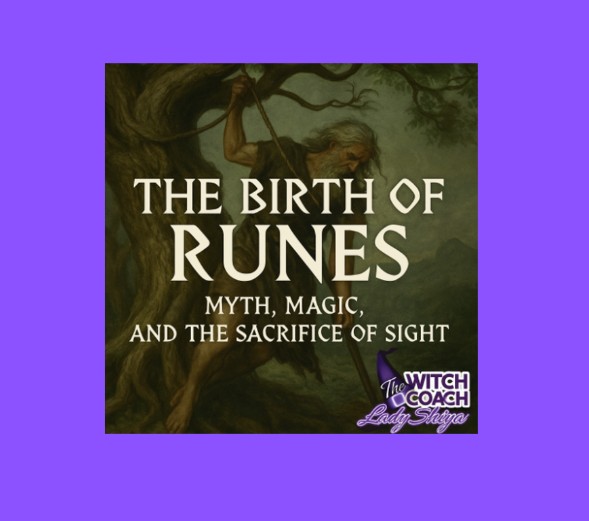
The story is simple in shape but vast in meaning: Odin, the Allfather, hung himself upon Yggdrasil—pierced by his own spear, denied food and water, suspended between life and death for nine nights. He offered himself to himself, giving up the security of godhood for a deeper, more dangerous form of knowing.
This was not martyrdom. It was initiation.
He hung there in the winds of the world, watching visions rise and fade, flesh weakening, spirit thinning, until he slipped into a state beyond ordinary perception. And in that liminal unraveling, the runes revealed themselves—flashing up from the depths below like sparks, like living truth.
When Odin seized the runes, he did not “learn a new alphabet.”
He grasped the raw, primal forces that make up existence.
The runes are not symbols of reality—they are the bones reality is built upon.
And because Odin suffered for them, they carry a lineage of sacrifice, surrender, and clarity born of pain. Working with the runes means working with this legacy of transformation. The runes don’t flatter. They don’t bend themselves to comfort. They show what is—and what must become.
This is why witches, seers, and mystics across centuries approach the runes with reverence. You aren’t merely reading them… you’re stepping into a centuries-old contract forged in the dark against the roots of the World Tree.
Runes as Living Forces, Not Letters
One of the most important things a modern reader must unlearn is the idea that runes are a writing system first and a magical system second. That concept belongs to modern linguistics—not ancient reality.
To early practitioners, the runes were:
Alive.
Volatile.
Potent.
Responsive.
Each rune was understood as a power, a presence with personality and influence. They didn’t just represent concepts—they were those concepts.
Kenaz wasn’t “the letter K.”
It was fire… illumination… craft… transformation.
Algiz wasn’t “the letter Z.”
It was protection, instinct, the antlered guardian rising between you and harm.
The runes were invoked, carved, spoken, sung, etched into wood or bone or stone to awaken the force they embodied. They could bless, fortify, heal, curse, shield, guide, or unmake—depending on the practitioner’s will and skill.
This is why modern readers who treat runes like flashcards miss the heart of the craft.
You don’t memorize runes…
You build relationships with them.
Early Magical Uses: Where Divination and Spellcraft Begin
Before the runes were gathered into neat sets for divination, they appeared in the wild—on weapons, amulets, stones, and boundary markers. These weren’t decorations. They were workings… spells… intentions fixed into the world.
Early runic magic included:
Inscriptions
Names, blessings, warnings, dedications.
A rune carved into wood or bone was a declaration of force.
Charms
Etched onto amulets to protect warriors, guide travelers, bless harvests, or invoke luck.
Healing and Protection
Runes used for cleansing, strengthening, warding, or anchoring personal power.
Bindrunes
Two or more runes fused into a single symbol to create a blended, amplified intention.
Bindrunes aren’t “aesthetic combinations.” They’re engineered spellwork.
Divination Hints
While full runecast sets came later in historical record, the practice of reading signs—bones, stones, omens—was deeply rooted in Norse culture. The runes naturally evolved into one of the most direct ways to speak with the unseen.
Even these early uses tell us something important:
Runes have always been tied to intention… to shaping outcomes… to interacting with the fabric of reality itself.
This is why we do not approach them lightly.
They respond to clarity, honesty, and willingness to see the truth—even when it’s uncomfortable.
Closing the Lesson: A Step Toward the Tree
By learning how the runes entered the world, you begin the work of entering their world. Odin’s sacrifice isn’t just a story—it’s a reminder that knowledge worth having requires vulnerability, humility, and transformation.
As you move deeper into this path, remember:
The runes do not belong to you.
You build trust with them.
You listen.
You learn their voices.
You let them challenge you, disrupt you, and wake you.
This is the beginning of that relationship.
Reflection for Lesson One
Sit quietly for a moment today and picture the World Tree not as a myth, but as a map of your inner landscape… roots, trunk, branches, connections.
Ask yourself:
What am I willing to see…
and what am I willing to release…
in order to learn the language of these ancient forces?
Write down what rises.
This is the first entry in your runic grimoire… the first thread of your own weaving with the runes.
Learn more about Runes by signing up for Lady Shiya’s online classroom.

 CJ Emery
  Doreen Scanlan
  Tom T. Moore