

Exploring the connection between consciousness, the heart, ancient wisdom, and the nature of reality
Gregg Braden is an author, educator, and lecturer whose work explores the relationship between modern science, ancient spiritual traditions, and human potential. Drawing on subjects ranging from geology and genetics to consciousness and sacred texts, Braden invites readers to reconsider what it means to be human and how our beliefs, emotions, and intentions may influence the way we experience the world.
A central theme throughout his work is that humanity may have capacities we have not fully understood. He explores the possibility that the heart, the mind, and consciousness are connected in ways that extend beyond conventional explanations, and he encourages people to look at ancient teachings alongside contemporary scientific discoveries.
From Technology to Spiritual Exploration
Braden’s professional journey began in the technical and scientific world. He studied earth sciences, marine geology, marine biology, geology, and remote sensing before earning a bachelor’s degree with honors in structural geology and earth sciences. During the energy crisis of 1979, he worked full time as a geological computer technician while completing his studies.
From 1979 to 1991, he worked as a problem solver for major companies during periods of crisis. His career included work as a senior computer systems designer at Martin Marietta, now part of Lockheed Martin, and a position at Cisco Systems, where he became its first Technical Operations Manager in 1991.
His technical background gave him experience in systems, patterns, and problem-solving. Later, his interests expanded into questions about consciousness, spirituality, and the wisdom preserved in ancient traditions.
Braden traveled to places including Tibet, Peru, and Nepal to explore spiritual teachings, ancient texts, and traditional understandings of the human experience. His work grew into an effort to bring these traditions into conversation with modern scientific ideas.
The Divine Matrix: An Interconnected Universe
One of Braden’s best-known concepts is the Divine Matrix, the subject of his book The Divine Matrix. He describes it as an intelligent, energetic field connecting everything in the universe—a kind of underlying framework through which consciousness and physical reality may be related.
In Braden’s interpretation, this connection suggests that human beings are not isolated observers of the world. Instead, our thoughts, beliefs, and emotions may participate in a larger field of relationship and possibility.
He draws on quantum physics to explore these ideas, suggesting that the universe may be more interconnected than everyday experience implies. His spiritual interpretation goes further than established physics, however. The claim that human emotions directly program a universal quantum field is a metaphysical proposition, not a demonstrated scientific conclusion.
For readers interested in the meeting point of spirituality and science, the Divine Matrix offers a way to contemplate the possibility that consciousness is deeply connected with the world around us.
The Heart, the Brain, and Emotional Coherence
Another important theme in Braden’s work is the relationship between the heart and the brain. He emphasizes the importance of emotions such as gratitude, appreciation, compassion, and love, and explores how these states may influence our experience of life.
The HeartMath Institute’s work on heart-brain coherence is part of the broader conversation surrounding these ideas. HeartMath describes coherence as a state associated with coordinated patterns in heart rhythms and other physiological processes. Practices involving breathing and positive emotional focus are used to encourage this state.
Braden presents heart-centered living as more than a technique for relaxation. In his framework, the heart is an important center of human intelligence and a means of engaging with the world through intention and emotion.
It is useful to distinguish the established study of the heart’s nervous system and physiological signaling from broader claims that the heart independently makes decisions or that positive emotions can directly alter external reality. The spiritual significance Braden gives these ideas is an interpretation rather than a settled scientific finding.
Nevertheless, the practical invitation to cultivate appreciation, compassion, and emotional awareness can be explored as a personal practice, without needing to accept every proposed scientific explanation.
The Human Blueprint and Our Potential
Braden also explores human genetics and the possibility that our biological makeup holds capacities that are not yet fully understood. In his discussions of the human genome, he has described what he sees as intelligent information encoded within our biology and considered what this might mean for human origins and potential.
His ideas challenge conventional accounts of human development, particularly when he interprets genetic features as evidence of intentional design. He connects these questions with spiritual traditions that describe humanity as having a meaningful purpose and an innate capacity for transformation.
His claims about deliberate genetic engineering, the origins of human beings, and the ability to activate longevity mechanisms through consciousness should be understood as his interpretations, not established conclusions of genetics. Still, these subjects raise questions that are important to his larger message: How much of our potential do we understand, and how might our choices influence the way we live?
For Braden, human potential includes the possibility of becoming more conscious of our inner lives and more intentional in how we respond to the world.
Fractal Time: Patterns That Repeat
In Fractal Time, Braden presents a view of time that differs from the familiar idea of a straight line moving from past to future. He proposes that time and history may contain recurring patterns, much like the repeating structures found in fractal geometry.
In this model, past events can provide clues about possible future periods of change. Braden suggests that by studying the patterns surrounding earlier events, we may identify similar windows of vulnerability or opportunity.
The concept offers a way to reflect on the relationship between history, human behavior, and the future. Its stronger predictive claims, including the idea that mathematical patterns can identify when particular crises will recur, are not established forecasting methods.
As a spiritual and philosophical idea, however, fractal time encourages us to consider whether we repeat familiar responses and whether greater awareness might help us make different choices.
Ancient Wisdom and Modern Questions
Braden’s work frequently returns to ancient spiritual traditions, including teachings associated with sacred texts and indigenous knowledge. He sees these traditions as sources of insight into consciousness, human purpose, and the relationship between the physical and spiritual worlds.
His books The God Code and The Isaiah Effect explore connections he draws between spiritual writings, human biology, prayer, and the possibility of a deeper order underlying existence. The Wisdom Codes considers the transformative potential of spiritual teachings, while Pure Human continues his exploration of human nature and potential.
A recurring feature of his approach is the search for parallels between ancient ideas and modern discoveries. These comparisons can inspire readers to ask new questions, although similarities between spiritual language and scientific terminology do not necessarily establish that the two describe the same phenomena.
His work is best approached with curiosity and discernment: appreciating the questions he raises while distinguishing documented scientific findings from spiritual interpretation and speculation.
A Message About Conscious Human Potential
Across his writing and lectures, Braden returns to the idea that human beings can participate more consciously in their own lives. He encourages people to pay attention to their emotions, examine their beliefs, and consider how their inner attitudes shape their relationships and decisions.
His approach brings together several areas of interest:
-
Consciousness: Becoming more aware of our thoughts, perceptions, and assumptions.
-
Emotional life: Exploring how gratitude, compassion, and appreciation affect our experience.
-
Spiritual traditions: Looking to ancient teachings for perspectives on human purpose and interconnectedness.
-
Human potential: Asking what we may learn about ourselves through continued study and self-reflection.
-
The future: Considering how individual and collective choices can influence the direction of human society.
Braden’s work has reached an international audience through books, films, lectures, and presentations. His ideas have been translated into many languages and have helped bring conversations about spirituality, consciousness, and science to readers who might not otherwise encounter them together.
Exploring the Questions
Gregg Braden’s work occupies a space between science, spirituality, and personal philosophy. Some of his subjects, such as the nervous system, genetics, and the study of physiological responses to emotion, connect with established areas of research. Other claims, particularly those involving a universal energetic field, consciousness altering physical reality, and precise predictions based on fractal time, remain speculative or are not supported by mainstream scientific evidence.
That distinction need not prevent readers from engaging with the questions at the heart of his work. What is the relationship between our inner lives and our physical experience? How can ancient spiritual traditions inform modern reflection? What does it mean to live with greater awareness, compassion, and responsibility?
For those drawn to the intersection of science and spirituality, Braden offers a broad landscape of ideas to explore. His work invites readers to remain curious about human potential while bringing thoughtful discernment to the explanations offered for it.
Gregg Braden’s website: https://greggbraden.com/
Gregg Braden’s Books
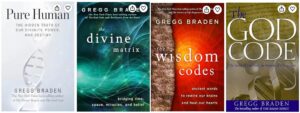
Find his books on Amazon: https://www.amazon.com/stores/Gregg-Braden/author/B001IYZHWI?ref=ap_rdr&shoppingPortalEnabled=true&ccs_id=341d5f6c-9a71-47b5-9ae0-83674cc1b5c8
Gregg Braden’s YouTube Video

 Mike Todd